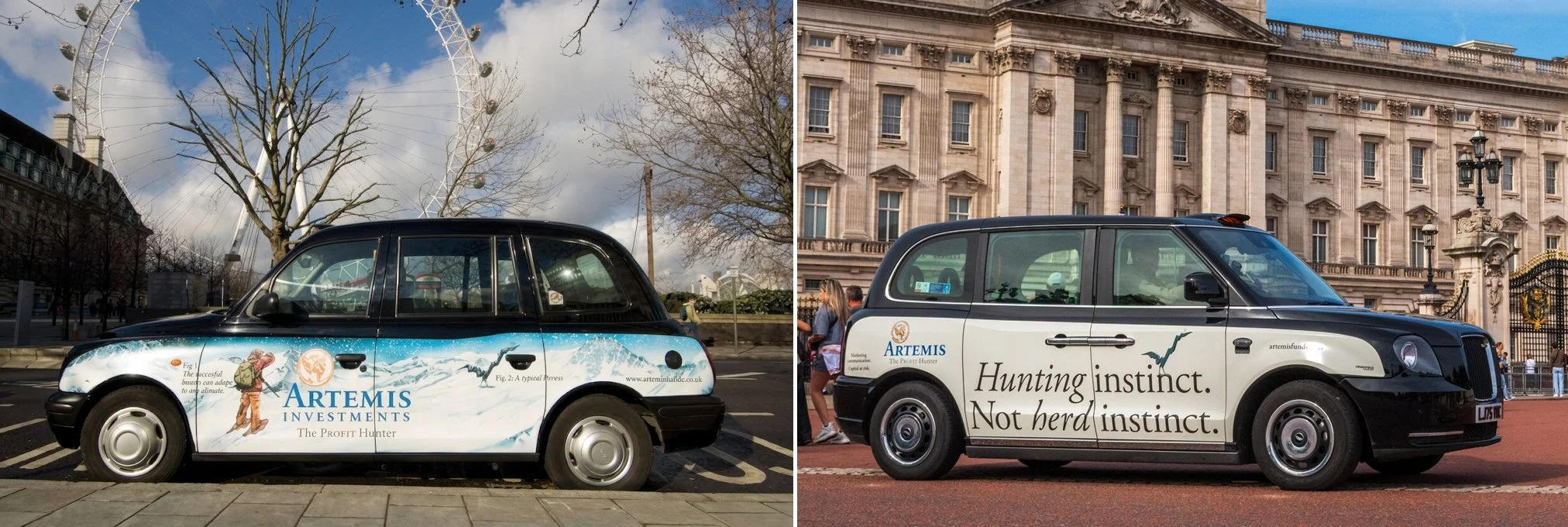
Above: Artemis Finance have been with us for the whole journey, proving that when something works, there's no need to change it
This year Ubiquitous turns 21.
A lot has changed in outdoor advertising over that time, but the basic idea behind taxi advertising hasn’t: a brand takes over the exterior of a taxi and its message travels through the streets where people live, work and move around.
That is why a study from twenty-one years ago, in 2005, is still worth reading. Published in the International Journal of Advertising, it saw Cleopatra Veloutsou and Claire O’Donnell survey 425 people in Glasgow, Edinburgh and Ayrshire. They asked how people encountered taxi advertising, how they felt about it and how it compared with other outdoor formats. The authors described the medium as not previously researched.
The questions they asked are still those of value today: do people notice, read and remember advertising on taxis?
So what did the research find, and how does it compare in 2026?
People notice(d) taxi advertising
In the 2005 study, 66% of respondents agreed or strongly agreed that they often noticed advertisements on passing taxis. Some 64% said they often read them, while 46% said they looked at fully covered taxis more than regular taxis.
The findings suggest that the distinctive appearance of a taxi can help its advertising attract attention.
Our 2026 Attest research points in a similar direction. Across two surveys of 1,000 Londoners each, 94% of respondents said they noticed advertising on taxis. In a separate question, 77% agreed or strongly agreed that taxi ads attracted their attention because they were “a bit different from the norm”.
Taxi advertising is an established format, rather than a new arrival. But being familiar with a medium does not necessarily mean every execution blends into the background. A fully branded vehicle can still create a distinctive presence on the street. In 2026 80% agreed or strongly agreed that taxi ads feel fresh because they are seen in different places. Some 65% said they notice them because they appear in unpredictable places, while 66% said they notice them in locations where there is little other advertising.
Familiar brands, trusted presence
The 2005 study found that over half of respondents said they were familiar with brands advertised on taxis. The authors suggested that this pointed towards a role in the media mix for taxi advertising in reinforcing established brands. Branding is not the taxi medium's only strength, but it raises an interesting point: in 2026 we at Ubiquitous maintain that taxis are great for straightforward branding advertising.
Our 2026 research also explored trust. Some 59% of respondents agreed or strongly agreed that trusting black cabs made them more likely to trust the advertisements on them. As well as the vehicle contributing to noticeability, this suggests that perceptions of the vehicle may influence how people view the advertising it carries.
What makes taxi advertising memorable?
Grabbing attention is one thing, but encoding memory is quite another. Both pieces of research give us a useful perspective on how memorable people find the format.
The 2005 study explored this by asking people whether they remembered taxi advertisements more readily than print ads. One in five agreed. It was a comparison between two media, rather than a measure of how many people remembered taxi advertising at all.
Twenty-one years later and taxi advertising in UK cities is more common, both in terms of being a mainstay of the media landscape, and in terms of quantity of Ubiquitous taxis with advertising on.
Our 2026 Attest research asked the memorability question head-on and found that 67% of respondents agreed or strongly agreed that taxi advertising was memorable, compared with 50% for mobile advertising. And 68% said taxi ads were more memorable because they were not digital, while 60% agreed that taxi ads stood out even though they rarely remembered advertisements.
The questions are different, so these figures cannot tell us whether taxi advertising has become more memorable since 2005. But the contrast is interesting. Could a format that people encounter more routinely also have become more familiar and easier to recognise? The research cannot answer that, but it is a worthwhile question to consider.
What can a 2005 study tell us today?
There is a serendipity behind this article. As Ubiquitous marks its 21st year, we commissioned new research into how people perceive taxi advertising, only by total chance to discover a study exploring many of the same questions, published twenty-one years ago. With differing question phrasing, the surveys aren't always directly comparable, but reading them side by side has offered a useful perspective on the format, what makes it distinctive and the questions that are still worth asking.
The original research covered three areas of Scotland, including Glasgow and Edinburgh, both well-established Ubiquitous operating grounds. It explored people's reported experiences of taxi advertising, from how often they noticed it to whether they read ads and recognised the brands displayed. The paper's conclusion was not simply that taxi ads get noticed. It was that a relatively under-researched, mobile outdoor format appeared to perform better than expected because it could attract attention, reach people across different locations and moments of their day, and it offers branding strength within the media mix.
Twenty-one years later, our Attest research in London points to some very familiar themes. Of course, Two studies, twenty-one years apart is not a ‘pattern’. The two alone cannot tell us everything that has changed, especially with factors outside the scope of the surveys at play. But they do suggest that the format's enduring characteristics remain relevant: it still attracts attention, reaches people across different locations and moments of their day, and it continues to offer branding strength.
To look at it another way, beyond just the two surveys, perhaps part of the answer we are looking for is hiding in plain sight. Twenty-one years on, the principle remains remarkably consistent: simply, a brand owning the exterior of an iconic black taxi, reaching people as they move through everyday life. The core idea has endured. There’s a logic that states: if it isn’t broken, why fix it?
Veloutsou, C., & O’Donnell, C. (2005). Exploring the effectiveness of taxis as an advertising medium. International Journal of Advertising, 24(2), 217–239. https://doi.org/10.1080/02650487.2005.11072915